Introduction
Siding Installation can improve a home by helping protect the exterior wall system from weather while also changing its color, texture, proportions, and architectural character. Its performance depends on proper installation, water management, compatible materials, and maintenance.
Homeowners often think about siding mainly as a color or design choice.
However, siding also plays an important role in the exterior wall system.
It helps shield underlying materials from direct weather exposure while contributing to the overall look of the home.
Author: KCB Construction Editorial Team
Updated: October 2026
KCB Construction has 10 years of experience serving clients in the United States through residential and commercial construction and remodeling services.
Its exterior services include Siding Installation, framing, painting, Home Additions, New Construction, and other improvement work.
What Does Siding Actually Do for a Home?
Siding provides the visible outer finish of the wall system.
It can help reduce direct exposure to rain, wind, sunlight, and other exterior conditions.
Siding may help:
- Shed rain
- Protect underlying wall components
- Reduce direct weather exposure
- Create a finished exterior
- Support architectural style
However, siding does not work alone.
It must coordinate with other parts of the wall assembly, including flashing, weather-resistant layers, windows, doors, trim, and drainage details.
That is why Siding Installation should be viewed as part of an exterior system rather than a decorative layer only.
Is Siding Waterproof?
No.
Siding is generally designed to help shed water, but it should not be treated as a complete waterproof barrier.
Water can reach areas behind exterior cladding through joints, wind-driven rain, penetrations, or transitions.
That is why exterior wall systems may also rely on:
- Weather-resistant barriers
- Flashing
- Drainage
- Window details
- Door details
- Penetration details
- Roof-to-wall transitions
The exact wall assembly varies by building, materials, and project requirements.
Therefore, one installation method should not be assumed to work for every home.
How Does Siding Help Protect Exterior Walls?
Exterior cladding helps reduce direct exposure of the wall assembly to weather.
This can be important in areas that experience rain, snow, wind, and seasonal temperature changes.
Siding protection depends on several connected factors.
These may include:
- Surface coverage
- Drainage
- Material compatibility
- Proper fastening
- Flashing
- Trim
- Transitions
Proper Siding Installation matters because poor detailing can affect how water moves around windows, doors, corners, and other connections.
A good product alone cannot correct poor installation.
Likewise, good installation cannot compensate for serious problems in the wall system that remain unaddressed.
Why Is Moisture Management Important Behind Siding?
Moisture can come from rain, leaks, condensation, or other sources.
Even when siding sheds most rain, water may still reach areas behind the outer cladding.
That means wall assemblies need a way to manage moisture.
Important concepts may include:
- Drainage
- Drying
- Weather-resistant barriers
- Flashing
- Penetration details
Moisture problems should not simply be covered with new siding.
If active water damage is suspected, the underlying condition should be evaluated before Siding Installation begins.
A contractor cannot reliably diagnose hidden wall conditions without proper inspection.
Therefore, exterior remodeling should respond to what is actually present once accessible areas are evaluated.
What Signs May Indicate Siding Problems?
Some siding problems are visible from the exterior.
Possible warning signs may include:
- Loose siding
- Cracked sections
- Missing pieces
- Warped panels
- Visible gaps
- Damaged trim
- Staining
- Repeated moisture concerns
- Deteriorated caulking where applicable
- Exposed underlying materials
These conditions do not always mean the entire home needs new siding.
Localized damage may sometimes be repairable.
However, widespread or repeated problems may justify a more detailed evaluation.
Can Damaged Siding Affect More Than Appearance?
Yes.
Damaged siding may expose portions of the wall system to additional weather.
For example, missing or cracked sections can leave underlying materials more vulnerable to rain or wind.
However, visible siding damage does not automatically prove that structural damage exists behind the wall.
Inspection may be appropriate when damage is extensive, repeated moisture is present, or underlying materials are exposed.
Homeowners should avoid assuming either that the problem is minor or that complete replacement is automatically required.
How Does Siding Change the Appearance of a Home?
Siding covers a large portion of the exterior.
As a result, its color, texture, profile, and scale can strongly influence the overall appearance of the property.
Exterior design may be affected by:
- Architectural character
- Color
- Shadow lines
- Material texture
- Trim contrast
- Roof relationship
- Windows
- Doors
For example, a simple horizontal profile may create a different visual effect from a vertical accent or shingle-style detail.
Siding can also change how large or defined certain parts of the exterior appear.
Therefore, Siding Installation should consider both technical performance and visual balance.
How Should Siding Color Be Chosen?
Siding color should be selected as part of the entire exterior.
Homeowners should consider more than the siding sample alone.
Color relationships may include:
- Roof color
- Window color
- Exterior doors
- Trim
- Masonry
- Other exterior materials
- Homeowner preference
A small sample may also look different once installed across a large wall.
Natural light can influence how color appears throughout the day.
Therefore, homeowners may benefit from viewing larger samples outdoors when practical.
No specific siding color can guarantee higher property value.
The best choice should support the home’s architecture and the homeowner’s design goals.
Why Do Siding Profiles and Textures Matter?
Profile and texture influence the scale and character of an exterior.
Different siding styles can create different shadow lines and visual patterns.
Possible appearances may include:
- Horizontal siding
- Vertical accents
- Shingle-style products
- Smooth finishes
- Textured finishes
No one profile is best for every house.
The right choice depends on the building’s proportions, architecture, trim, and homeowner preferences.
Product options also vary by material and manufacturer.
Therefore, homeowners should review actual product specifications rather than assuming all siding within one category looks or performs the same way.
How Should Siding Work With Exterior Trim?
Trim helps define the edges and transitions of a home’s exterior.
It often appears around windows, doors, corners, rooflines, and other architectural features.
Important trim relationships may include:
- Window trim
- Door trim
- Corner details
- Fascia
- Soffit relationships
- Color contrast
- Scale
Siding and trim should look intentional together.
For example, very narrow trim may create a different visual effect from wider exterior details.
Color contrast can also emphasize windows, doors, or corners.
Therefore, trim should be selected as part of the exterior design rather than added as an unrelated final detail.
How Does Siding Work Around Windows and Doors?
Windows and doors are major penetrations in exterior walls.
That makes their transitions especially important.
Siding around these openings may need to coordinate with:
- Flashing
- Trim
- Wall layers
- Window systems
- Door systems
- Manufacturer requirements
Water management around openings should not depend on surface caulking alone.
Instead, the details should work with the broader wall system.
Because products and assemblies differ, homeowners should avoid using one generic installation approach for every project.
Professional Siding Installation should account for the specific wall, window, door, and cladding systems being used.
Can Siding Affect Energy Efficiency?
Siding can be part of an exterior assembly, but siding alone does not determine energy performance.
The entire wall system matters.
Energy performance may depend on:
- Insulation
- Air sealing
- Windows
- Doors
- Thermal bridging
- Wall construction details
Some siding products may include insulated components.
However, product performance varies.
Homeowners should review manufacturer documentation and project-specific conditions before assuming a particular siding product will create significant energy savings.
Siding Installation should therefore be coordinated with the existing or planned wall assembly.
What Siding Materials Are Commonly Used?
Several types of siding are commonly used on residential buildings.
Possible categories include:
- Vinyl siding
- Fiber cement siding
- Wood siding
- Engineered wood products
- Other manufactured cladding systems
No material is universally best.
Material selection may depend on:
- Appearance
- Maintenance
- Weather exposure
- Installation requirements
- Homeowner priorities
- Budget
- Manufacturer specifications
The home’s architecture may also influence the decision.
A material that looks appropriate on one house may not create the same result on another.
Is Vinyl Siding a Good Option?
Vinyl siding is a common residential exterior cladding option.
It is available in a range of colors and profiles.
Homeowners may consider factors such as:
- Maintenance
- Color options
- Profile options
- Installation requirements
- Expansion and contraction
- Manufacturer instructions
Vinyl siding must be installed according to the requirements of the specific product.
That includes allowing for expected movement and following manufacturer recommendations.
It is not appropriate to make one universal lifespan claim for all vinyl siding products.
Weather exposure, installation quality, maintenance, and product specifications all matter.
What Should Homeowners Know About Fiber Cement Siding?
Fiber cement is another exterior cladding option used on residential buildings.
It can provide a different appearance and material character from vinyl or wood.
Homeowners may consider:
- Appearance
- Product weight
- Installation requirements
- Manufacturer clearances
- Finishing requirements
- Maintenance
Fiber cement products may have specific cutting, fastening, clearance, and finishing requirements.
Therefore, installation should follow current manufacturer documentation.
Homeowners should not assume every fiber cement product uses identical installation details.
When Does Siding Repair Make Sense?
Repair may make sense when damage is limited and surrounding siding remains serviceable.
Possible situations may include:
- Isolated damage
- A small number of loose pieces
- Localized impact damage
- Selected trim concerns
However, older siding may be difficult to match exactly.
Color can change with age and exposure.
Some profiles may also become unavailable.
Therefore, even a small repair may require a discussion about how the new material will look beside the existing siding.
When Might Siding Replacement Make More Sense?
Replacement may be considered when damage is widespread, materials are significantly deteriorated, or the homeowner is planning a broader exterior update.
It may also make sense when multiple areas require repair.
However, replacement should not be treated as the automatic answer to every visible defect.
The condition of the existing siding, underlying wall materials, trim, openings, and moisture-management details should be considered together.
A project-specific evaluation can help determine whether repair or replacement is more appropriate.
Why Does New England Weather Matter for Siding?
Homes in New England can experience rain, snow, wind, freezing conditions, and seasonal temperature changes.
These conditions make exterior detailing and routine observation important.
Weather exposure can affect siding, trim, joints, and transitions over time.
However, climate alone does not determine the condition of a home’s exterior.
Material choice, installation quality, maintenance, orientation, and building design also influence performance.
For homeowners in Woburn, Middlesex County, and the Greater Boston Area, siding should be selected and installed with local weather exposure in mind.
When Should You Talk to a Siding Contractor?
Homeowners may benefit from professional input when siding damage is widespread, moisture concerns keep returning, or multiple exterior areas need work.
A contractor can also help when a full exterior update is being planned.
Useful topics may include:
- Existing siding condition
- Repair versus replacement
- Wall preparation
- Moisture concerns
- Window and door transitions
- Trim
- Siding materials
- Manufacturer requirements
- Exterior design goals
KCB Construction provides Siding Installation and related exterior construction services in Woburn, Middlesex County, and the Greater Boston Area.
Its services also include framing, painting, Home Additions, New Construction, and other residential and commercial improvements.
Once homeowners understand siding condition, wall transitions, material choices, moisture concerns, and design goals, they can move into preparation, installation quality, weather planning, maintenance, contractor selection, and broader exterior renovation decisions with a clearer plan.
Why Is Proper Preparation Important Before Siding Installation?
Successful Siding Installation begins before the new cladding is attached.
The condition of the existing wall system can influence how the new siding should be installed.
Preparation may involve reviewing:
- Existing siding
- Wall condition
- Moisture concerns
- Sheathing condition
- Weather-resistant layers
- Flashing
- Windows
- Doors
- Trim
- Penetrations
Not every project requires complete siding removal.
However, removing existing materials may reveal conditions that were not visible during the original inspection.
For example, damaged sheathing or signs of moisture may only become visible after older siding is removed.
Those conditions should be evaluated before new materials cover the wall again.
Why Does Installation Quality Matter So Much?
Even a high-quality siding product can perform poorly if installation requirements are ignored.
Details such as fastening, spacing, movement, flashing, clearances, joints, and transitions all matter.
Key areas include:
- Fastening
- Spacing
- Expansion and contraction
- Flashing
- Clearances
- Joints
- Trim
- Penetrations
- Manufacturer instructions
Different siding products have different installation requirements.
Therefore, Siding Installation should follow the current instructions for the specific material being used.
How Does Flashing Support Siding Performance?
Flashing helps manage water at transitions where the wall system may be more vulnerable.
These areas often include openings or places where different materials meet.
Examples may include:
- Windows
- Doors
- Roof-to-wall intersections
- Penetrations
- Horizontal transitions
Flashing should work with the wall assembly rather than as an isolated detail.
The correct approach depends on the siding, wall system, opening, and manufacturer requirements.
Why Does Weather Planning Matter During Siding Installation?
Exterior work is directly exposed to changing weather.
Rain, snow, wind, temperature, and seasonal conditions can influence installation planning.
New England weather can change quickly during some parts of the year.
Therefore, contractors may need to adjust work sequencing or temporary protection based on site conditions.
Some siding manufacturers also provide product-specific temperature or storage guidance.
Homeowners should rely on current manufacturer documentation rather than one universal weather rule.
Should Old Siding Always Be Removed?
No.
Whether old siding should be removed depends on the existing material, condition, wall assembly, project goals, and installation requirements.
Important factors may include:
- Existing siding type
- Existing condition
- Wall flatness
- Moisture concerns
- Manufacturer instructions
- Local requirements
- Project goals
In some projects, removal may be necessary to inspect or repair underlying materials.
In others, a particular system may allow a different approach.
The decision should be made for the actual house and product rather than by assuming one method works everywhere.
Can New Siding Be Installed Over Old Siding?
Sometimes, but not in every situation.
Some products and wall conditions may allow installation over an existing surface.
Other projects may require removal.
Suitability can depend on:
- Existing material
- Surface flatness
- Moisture conditions
- Wall condition
- Manufacturer requirements
- Applicable local requirements
Homeowners should confirm project-specific requirements before deciding whether existing siding will remain.
What Are the Most Common Siding Installation Mistakes?
Many siding problems come from poor preparation or poor coordination rather than the siding product itself.
Common mistakes include:
- Poor wall preparation
- Ignoring water management
- Incorrect flashing
- Improper fastening
- Poor alignment
- Ignoring material movement
- Poor window transitions
- Poor trim coordination
- Covering damaged materials
- Ignoring manufacturer guidance
- Poor material storage
- Treating siding as waterproof
Repeated errors may affect both performance and appearance.
For example, poor alignment can make the exterior look uneven.
Meanwhile, poor water-management details may create more serious concerns behind the siding.
How Can Siding Improve Curb Appeal?
Siding can dramatically change the visual character of a home because it covers a large percentage of the exterior.
Color, profile, texture, and trim all influence that effect.
Exterior improvements may involve:
- Color
- Texture
- Profile
- Trim
- Corners
- Architectural details
- Doors
- Windows
A new siding color may make trim details more visible.
Likewise, a different profile can change the scale and shadow lines of the exterior.
However, siding should not be assumed to increase property value by a specific amount.
Its visual impact depends on design, installation quality, condition, and homeowner preferences.
Should Siding Match the Architectural Style of the House?
Often, siding looks more natural when it supports the proportions and character of the home.
That does not mean every original detail must be copied.
Homeowners may consider:
- Siding profile
- Color
- Trim
- Vertical accents
- Gables
- Window details
- Rooflines
A traditional home may use different proportions from a modern exterior.
Meanwhile, homeowners may intentionally simplify or update some details.
The goal is visual coordination rather than rigid imitation.
Can You Mix Siding Styles or Materials?
Yes.
Different siding styles and materials can work together when the transitions are planned carefully.
Possible combinations include:
- Horizontal siding with vertical accents
- Siding with masonry
- Shingle-style accents
- Contrasting gables
- Different textures
However, too many unrelated materials can make the exterior feel disconnected.
Repeated colors, trim details, or proportions can help different materials feel intentional.
How Should Siding Work With Exterior Painting?
Some siding products come with factory-applied finishes.
Others may be painted or refinished depending on the product and manufacturer guidance.
Exterior painting may also involve:
- Trim
- Exterior doors
- Fascia
- Soffits where applicable
- Other compatible surfaces
KCB Construction provides Exterior Painting along with Siding Installation and other exterior construction services.
Coordinating paint and siding can help color relationships remain consistent across the exterior.
However, coating requirements should always follow the specific material and manufacturer.
How Does Siding Connect With Home Additions?
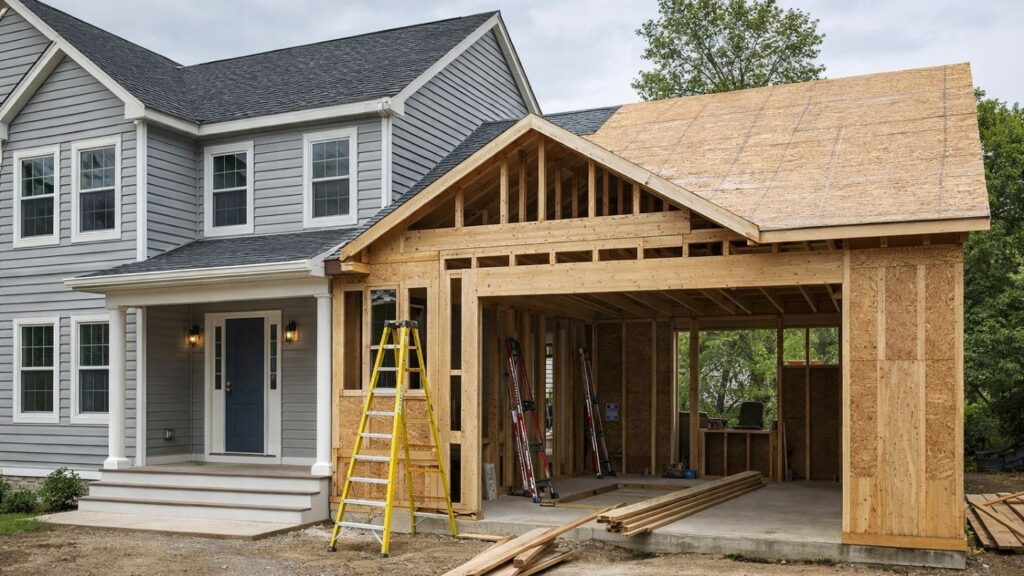
Home Additions often create a transition between new exterior walls and the existing house.
That makes siding coordination especially important.
Consider:
- Matching existing siding
- Intentional contrast
- Trim
- Rooflines
- Windows
- Corners
- Material transitions
Exact matching may not always be possible.
Older siding may have weathered, changed color, or become unavailable.
In those cases, an intentional transition may be more practical than trying to create an imperfect match.
KCB Construction provides Home Additions and Siding Installation, allowing exterior transitions to be considered as part of the larger project.
How Does Siding Fit Into New Construction?
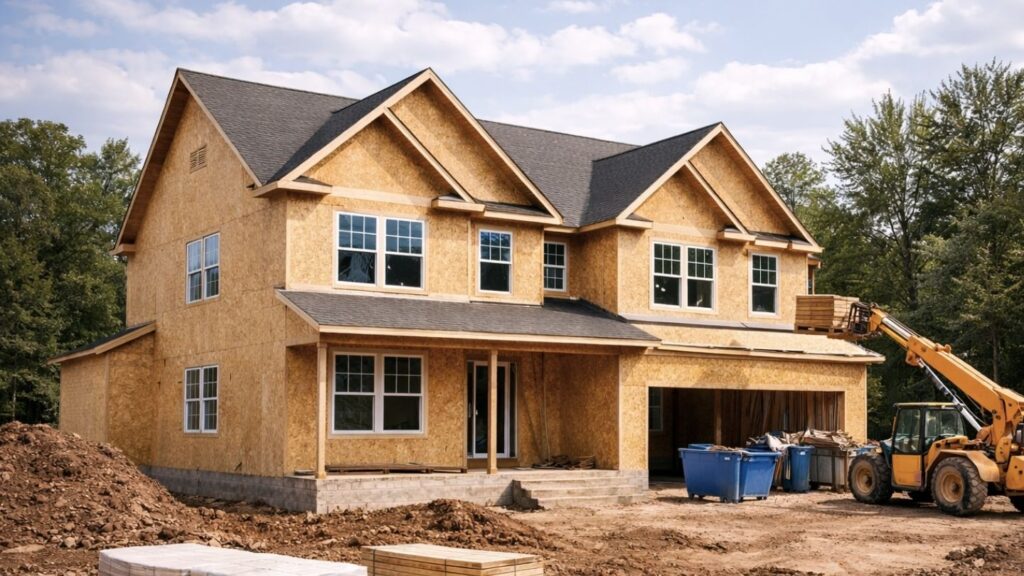
Siding is one part of the complete exterior wall system in New Construction.
It works with multiple building components.
These may include:
- Framing
- Sheathing
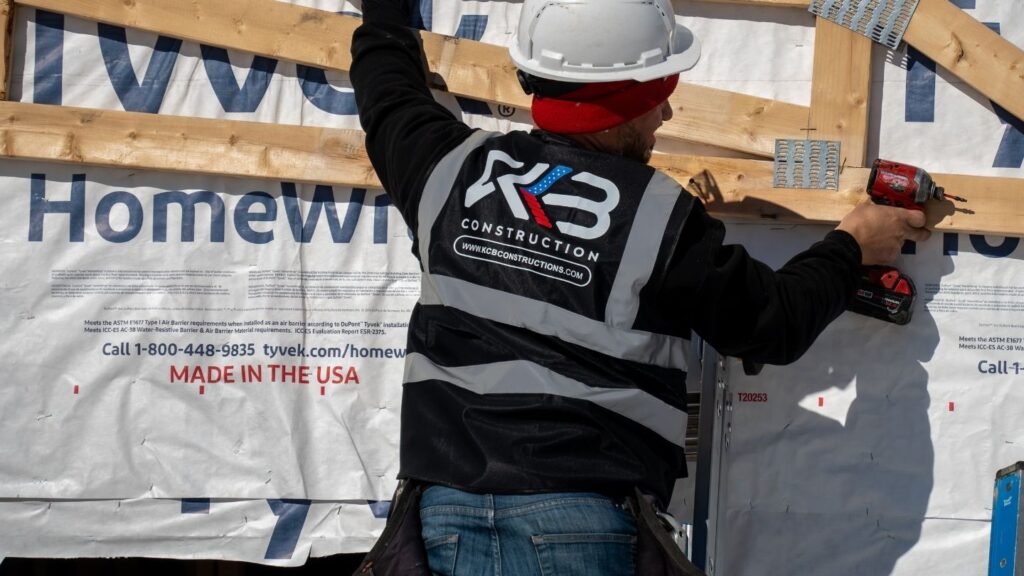
- Weather-resistant layers
- Insulation
- Windows
- Doors
- Roofing
- Exterior trim
Each layer has a different role.
Therefore, Siding Installation should be coordinated with earlier construction stages instead of being treated as an isolated finish.
KCB Construction provides New Construction, Framing, and Siding Installation for residential and commercial projects.
What Maintenance Does Siding Require?
Maintenance depends on the siding material and manufacturer.
No siding product should automatically be considered completely maintenance-free.
Possible maintenance needs may include:
- Cleaning
- Visual inspection
- Repainting certain materials
- Checking damaged sections
- Inspecting joints or trim
- Addressing impact damage
Homeowners should follow manufacturer care instructions for their specific siding product.
Routine observation can also help identify visible changes before they become more extensive.
How Often Should Homeowners Inspect Siding?
There is no universal inspection schedule that applies to every home.
However, homeowners can periodically look for visible damage and check the exterior after significant weather when appropriate.
Watch for:
- Loose materials
- Cracks
- Gaps
- Damaged trim
- Staining
- Impact damage
Changes should be evaluated in context.
A small cosmetic issue may require a different response from widespread damage or repeated moisture concerns.
What Should You Look for in Quality Siding Installation?
Quality Siding Installation should look consistent while also supporting proper exterior detailing.
Homeowners may look for:
- Consistent alignment
- Clean transitions
- Coordinated trim
- Appropriate clearances
- Finished openings
- Consistent profiles
- Clean corners
- Manufacturer-compatible details
Existing homes may contain walls or openings that are not perfectly uniform.
Therefore, quality work should respond carefully to real conditions rather than assume every surface is perfectly straight.
How Do You Choose a Siding Contractor?
A siding contractor should be able to explain both the visible work and the preparation behind it.
Useful questions include:
- What is the condition of the existing siding?
- Will any siding be removed?
- Will the wall be evaluated?
- How are moisture concerns handled?
- How is flashing coordinated?
- What weather-resistant layers are involved?
- What siding material is being used?
- What trim is included?
- How are windows and doors handled?
- Which manufacturer requirements apply?
- Are permits required?
- Is cleanup included?
- Who supplies materials?
- How are changes communicated?
- What warranty documentation applies?
Homeowners should understand both what is included and what is excluded from the proposal.
This helps reduce confusion once work begins.
Why Is Professional Coordination Important for Siding Installation?
Exterior remodeling may involve more than siding alone.
A project can include:
- Siding
- Flashing
- Trim
- Windows
- Doors
- Roof transitions
- Painting
- Framing repairs
- Wall preparation
One stage can affect another.
For example, replacing a window may change siding and trim details around the opening.
Likewise, wall repairs may need to happen before new siding is installed.
KCB Construction provides Siding Installation and related exterior construction services for homeowners in Woburn, Middlesex County, and the Greater Boston Area.
Is Siding Replacement Worth Considering During a Larger Exterior Remodel?
It can be.
Siding replacement may be easier to coordinate when other exterior work is already planned.
That work may include:
- Windows
- Doors
- Trim
- Painting
- Additions
- Roof transitions
However, combining projects does not automatically mean lower costs or faster completion.
The benefit is often coordination.
Related exterior details can be planned together rather than addressed as completely separate projects.
What Should You Ask Before Starting Siding Installation?
Before work begins, homeowners should understand the existing conditions, material choice, installation responsibilities, and exterior transitions.
Ask:
- What condition is the existing siding in?
- Will any siding be removed?
- Are moisture concerns present?
- What siding material is being used?
- How will windows and doors be detailed?
- What trim is included?
- How will flashing be handled?
- Which manufacturer requirements apply?
- Who supplies materials?
- Is cleanup included?
- Are permits required?
- How will changes be communicated?
These questions can help homeowners better understand the scope before Siding Installation begins.
Frequently Asked Questions About Siding Installation
What Does Siding Protect a Home From?
Siding helps shield the exterior wall system from direct exposure to rain, wind, sun, and other weather.
However, it works with flashing, weather-resistant layers, and other wall components.
Is Siding Waterproof?
No.
Siding generally helps shed water but should be part of a broader moisture-management system.
Flashing, drainage, and weather-resistant layers also play important roles.
Does New Siding Improve Energy Efficiency?
Siding alone does not determine energy performance.
Insulation, air sealing, windows, doors, wall construction, and other details also affect the building envelope.
Specific product performance should be verified with the manufacturer.
How Do I Know if My Siding Needs Replacement?
Widespread deterioration, repeated damage, recurring moisture concerns, or a planned major exterior renovation may justify evaluation.
Visible damage does not automatically mean complete replacement is necessary.
Can New Siding Change the Appearance of My Home?
Yes.
Color, texture, profile, trim, windows, doors, and other exterior details can significantly change the visual character of a home.
Which Siding Material Is Best?
There is no universal best siding material.
The right option depends on appearance, maintenance, exposure, installation requirements, manufacturer guidance, and homeowner priorities.
Should I Hire a Professional for Siding Installation?
Professional installation can be valuable because exterior cladding must coordinate with wall conditions, flashing, windows, doors, trim, penetrations, and manufacturer requirements.
Project complexity should guide the decision.
How Can Siding Protect and Transform Your Home?
Siding contributes to both exterior protection and appearance when it works as part of a complete wall system.
Material choice matters, but preparation and installation quality matter just as much.
Flashing, trim, openings, transitions, weather-resistant layers, and maintenance all influence the final result.
At the same time, color, texture, profile, and architectural details can give the exterior a noticeably different character.
Well-planned Siding Installation therefore combines technical coordination with thoughtful exterior design.
Contact KCB Construction Today to discuss Siding Installation, siding condition, exterior protection, siding replacement, material options, trim, windows, doors, and exterior remodeling goals. We serve Woburn and the Greater Boston Area with thoughtful planning, quality workmanship, personalized service, and professional project execution.